The Parent’s Role in a Young Golfer’s Journey
By SWP Golf ·
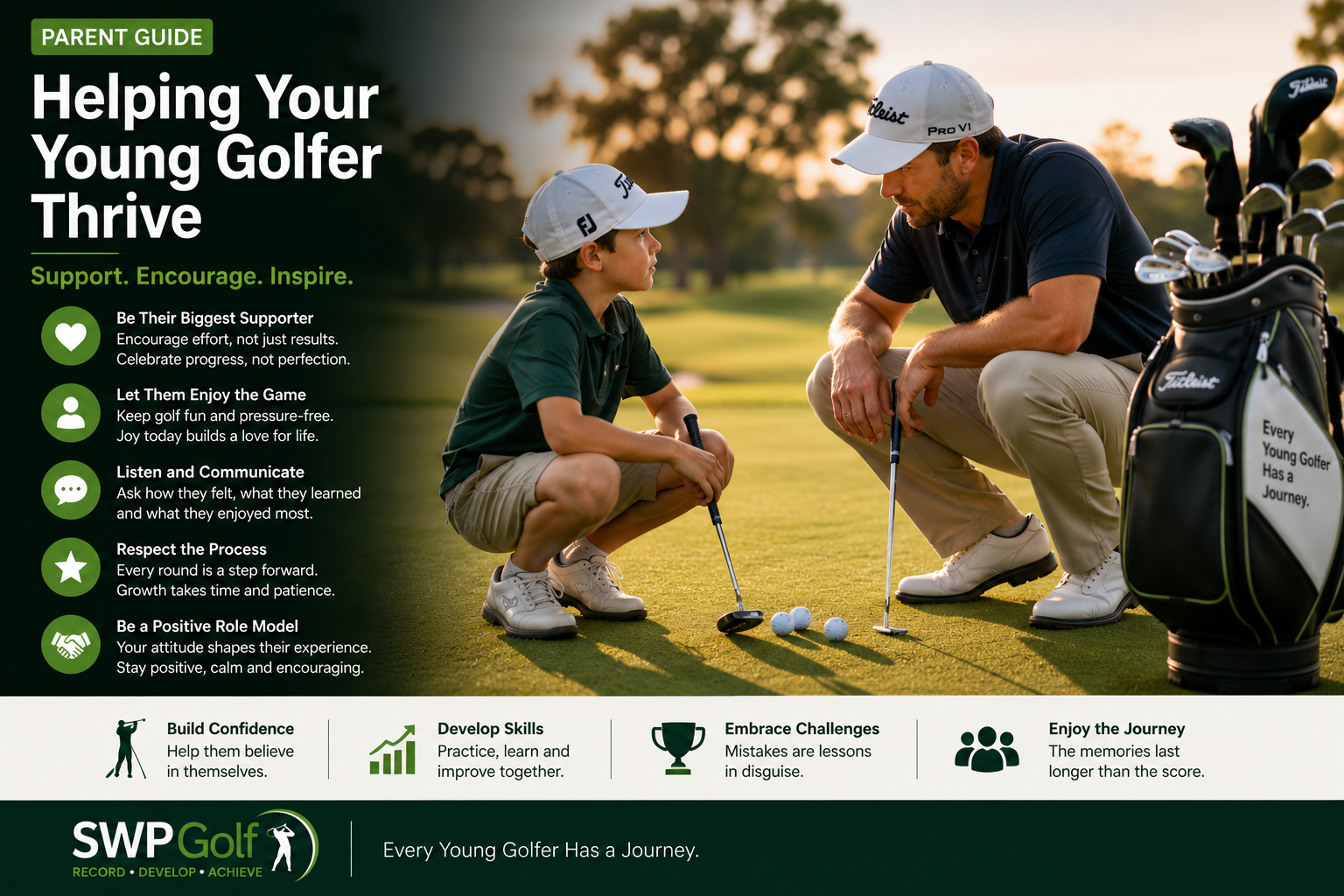
The Parent’s Role in a Young Golfer’s Journey
Support Them, Encourage Them — But Let the Game Belong to Them
Watching your child walk onto a golf course can be one of the great pleasures of being a parent.
You see the good shots, the missed putts, the excitement of a personal best and the disappointment when a round doesn't go as planned. Naturally, you want to help.
But in junior golf, how a parent helps can be just as important as the help itself.
Golf Australia’s parent code makes a particularly important point: children participate in sport for their own enjoyment, and parents should focus on effort and performance rather than simply winning or losing.
For parents of young golfers, perhaps the best starting point is simple:
Be their parent first. Let their coach be their coach.
Don't Turn the Drive Home Into Another Lesson
Your young golfer walks off the 18th after a difficult round.
They know they missed the short putt.
They remember the ball they put in the water.
They probably don't need to hear:
"Why did you hit driver there?"
"Your coach told you not to do that."
"You should have scored much better today."
Even when those comments are well intended, a child can hear them as disappointment.
PGA guidance for parents consistently recommends keeping technical instruction limited and praising the process rather than simply the result.
A better question after a round might be:
"Did you enjoy yourself?"
Or:
"What was your favourite shot today?"
And sometimes the best thing to say is nothing about golf at all.
Let the Coach Do the Coaching
This can be difficult, particularly when Mum or Dad is a good golfer.
You see something in your child's swing and immediately want to fix it.
But imagine being a 12-year-old golfer hearing one instruction from your coach on Tuesday and another from Dad on Saturday.
It can quickly become confusing.
Modern junior development increasingly recognises the importance of the relationship between player, coach and parent, with each having a different role. The PGA describes that three-way relationship as fundamental to successful junior development.
The coach teaches.
The golfer learns and experiments.
The parent provides the environment, encouragement and opportunity.
That's a powerful combination.
Praise Things That Have Nothing to Do With the Score
Imagine your child shoots 92 but:
shakes hands with their playing partners;
congratulates another golfer after a great shot;
repairs pitch marks;
stays positive after making a triple bogey;
plays honestly when nobody else saw what happened; and
finishes the round without giving up.
That's a successful day.
Scores will eventually improve.
Character takes much longer to develop.
Golf Australia's guidance specifically asks parents to respect officials, appreciate good performances from all players and act as positive role models.
These are some of golf's greatest lessons.
Don't Compare Them With Other Young Golfers
"Jack is already playing off 8."
"Sarah won again."
"That boy is younger than you and hits it 30 metres further."
Comparisons rarely help.
Children grow at different rates physically, mentally and emotionally. Their golf develops differently too.
PGA junior coaching advice recommends avoiding comparisons with other children and instead talking about commitment, effort and improvement.
A much healthier comparison is:
Your child today versus your child six months ago.
That's progress.
Don't Make Your Dream Their Dream
Perhaps your child is talented.
You start thinking about state teams.
Scholarships.
National championships.
Maybe even professional golf.
There's nothing wrong with dreaming.
But make sure it's their dream too.
A young golfer might want to become a professional.
Another might simply want to play Saturday golf with friends.
Both can have a wonderful relationship with the game.
PGA guidance warns parents against assuming every junior needs to follow the same competitive pathway. The motivation ultimately needs to belong to the child.
Allow Them to Fail
This may be one of the hardest things for a parent to do.
Your child has a one-metre putt to win.
They miss it.
Your instinct is to protect them from the disappointment.
But golf has just taught them something.
Young golfers need opportunities to experience disappointment, frustration and periods when improvement seems to stop. Learning to handle those moments can be part of becoming both a better golfer and a more resilient young person.
You don't need to solve every bad round.
Sometimes your job is simply to be there.
Keep Golf in Perspective
A young golfer's handicap is not their identity.
Neither is their tournament ranking.
Neither is the number of trophies in their bedroom.
One piece of PGA guidance for parents puts particular emphasis on ensuring that golf never becomes what defines a child as a person.
Your child should know that whether they shoot 72 or 102, they're still coming home with the same parent.
That security can actually give young athletes greater freedom to compete.
They're allowed to fail.
Know When to Push — and When to Back Away
Support doesn't mean there should never be discipline.
If a young golfer says they want to improve, it's reasonable to encourage them to practise.
If they've committed to a tournament, they should learn to prepare properly.
If they've arranged a lesson, they should arrive on time and ready to learn.
But there is an important difference between encouraging commitment and forcing ambition.
Australian golf commentary on junior parenting makes the same distinction: parents can provide lessons, transport and tournament opportunities, but they cannot manufacture a child's desire to play.
Ask Better Questions
Instead of:
"What did you shoot?"
Try:
"What did you learn today?"
Instead of:
"Did you win?"
Try:
"What are you proud of?"
Instead of:
"Why did you hit that shot?"
Try:
"What would you do differently next time?"
These questions encourage a young golfer to think for themselves.
And eventually, that's exactly what they'll have to do on the course.
Remember Why They Started
Very few five-, eight- or ten-year-olds pick up a golf club because they're thinking about rankings or scholarships.
They hit the ball because it's fun.
They love seeing it fly.
They enjoy putting a ball into a hole.
They like spending time with Mum or Dad.
They meet friends.
PGA junior-development guidance continues to emphasise fun and social engagement as major reasons children stay involved with golf.
Protect that enjoyment.
There will be plenty of time for scorecards.
One Day You'll Miss These Rounds
There will come a day when you no longer have to drive them to practice.
They'll carry their own clubs.
They'll organise their own tee times.
They may have a different coach, move to another club or go away to university.
And perhaps one day they'll take their own children to the golf course.
That's why junior golf isn't only about creating better golfers.
It's about creating memories.
Where SWP Golf Fits
That's something we believe strongly at SWP Golf.
A junior's golf journey should record more than victories.
Their first lesson.
Their first nine holes.
Their first handicap.
Their first tournament.
The round where everything went wrong — but they finished anyway.
Their improvement.
Their friendships.
Their milestones.
And the people who supported them along the way.
Parents have an enormously important role in that story.
But perhaps the greatest gift a parent can give a young golfer is this:
Give them the opportunity. Give them encouragement. Give them support. Then give them enough space to make the journey their own.
SWP Golf — Every Young Golfer Has a Journey.