The New Age of Golf Technology
By SWP Golf ·
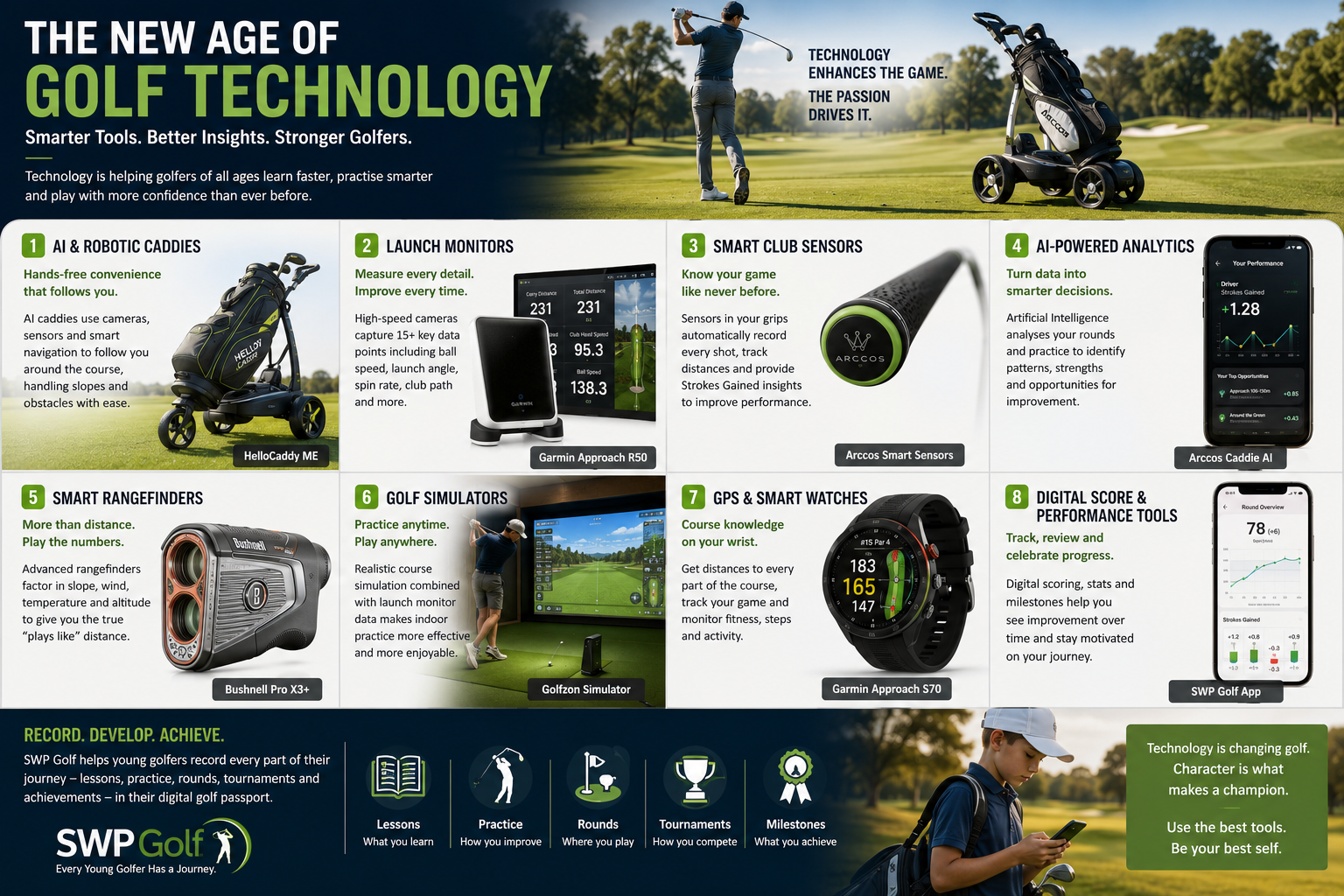
The New Age of Golf Technology
From AI Caddies to Launch Monitors — Technology Is Changing How Golfers Learn, Practise and Play
Golf has always been a game of feel, judgement and experience.
But walk onto a modern driving range or golf course in 2026 and you may see something that would have looked like science fiction only a generation ago.
A golfer can hit a ball while high-speed cameras measure the club and ball at impact. A GPS watch can map thousands of courses. Sensors can record virtually every shot in a round. Artificial intelligence can analyse performance and suggest where a golfer is losing strokes.
And now, robotic golf trolleys can even follow the golfer around the course.
For young golfers growing up today, technology is becoming another part of learning the game.
1. AI and Robotic Golf Caddies
The traditional golf buggy or trolley is becoming considerably smarter.
New robotic trolleys can follow their golfer automatically rather than needing to be pushed or continuously controlled.
The HelloCaddy ME, for example, uses an AI follow system, LiDAR tracking and automatic terrain balancing. Its manufacturer says the trolley can follow the golfer hands-free and handle slopes of up to 30 degrees.
Another emerging system, iXi, uses dual-camera vision and AI-powered motion tracking so the trolley can synchronise its movement with the golfer.
Meanwhile, established trolley manufacturers continue adding sophisticated GPS and remote-control technology. Motocaddy's 2026 range includes new remote-control and GPS models designed to make moving around the course increasingly hands-free.
For junior golfers, the interesting part isn't simply having a clever machine carry the clubs.
It's another example of technology allowing the golfer to concentrate more on walking, thinking and playing the game.
2. Launch Monitors — Measuring What Really Happens
Perhaps no technology has changed modern golf coaching more visibly than the launch monitor.
Instead of a coach simply saying, "That looked better," today's golfer can see what actually happened.
Ball speed.
Clubhead speed.
Launch angle.
Spin rate.
Spin axis.
Club path.
Face angle.
Angle of attack.
Carry distance.
Shot dispersion.
One example is the Garmin Approach R50, which uses three high-speed cameras to measure more than 15 ball and club metrics. It can even display high-speed video of the moment the club strikes the ball.
Garmin's newer Approach G82, announced in January 2026, combines a portable launch monitor with GPS and adds putting metrics, while containing more than 43,000 preloaded golf courses.
For a developing junior golfer, that information can be extremely useful when interpreted properly by a coach.
The numbers shouldn't replace coaching.
They can make coaching more measurable.
3. AI Can Now Help Analyse Your Golf
Artificial intelligence is beginning to move beyond being a novelty.
It can increasingly turn thousands of pieces of golf data into information a golfer can understand.
For example, Golfzon has been developing AI-powered golf coaching, including dynamic swing analysis and personalised coaching content. Its 2026 AI fitting service uses golfers' actual shot and round information to recommend equipment suited to their characteristics and preferences.
This points toward an interesting future.
Rather than simply being told:
"Your iron play needs improvement."
A golfer's system could eventually identify much more specific patterns:
"Your biggest scoring opportunity is approach shots from 100–130 metres."
That's a much more useful conversation to have with a coach.
4. Your Golf Clubs Can Record Your Game
Even the clubs in the golf bag can now become part of the technology.
Arccos Smart Sensors screw into the grips of individual clubs and automatically identify which club was used.
The system can then build a picture of real-world distances and performance for every club in the bag and use strokes-gained analysis to identify strengths and weaknesses. Its AI rangefinder technology can also adjust distances for factors including wind, elevation, temperature, humidity and altitude.
And in 2026, the technology went another step further.
Arccos Air is a small wearable device designed to automatically detect shots using GPS, a gyroscope and accelerometer — without requiring sensors on every club or a phone in the golfer's pocket.
Imagine a junior playing a round and, instead of trying to remember everything afterwards, having much of their performance recorded automatically.
5. Rangefinders Are Becoming Smart Caddies
The simple laser rangefinder has changed too.
Originally, the job was straightforward:
Point at the flag.
Press a button.
Get the distance.
Today's better devices can combine laser measurement, GPS, slope information and environmental data.
Some connected systems can factor in wind, temperature and altitude to produce a more realistic "plays like" distance.
That can teach young golfers an important lesson.
A 150-metre shot isn't always a 150-metre shot.
Wind, elevation, temperature, lie and course conditions matter.
Technology can provide the information.
The golfer still has to make the decision — and hit the shot.
6. Golf Simulators Are Becoming Training Centres
Golf simulators used to be mainly entertainment.
That has changed considerably.
Modern systems can combine high-speed cameras, launch monitors, realistic course simulation and detailed performance analysis.
The Garmin R50, for example, can simulate more than 43,000 courses and simultaneously operate as a serious training device, saving statistics for individual clubs and comparing sessions over time.
Golfzon's simulator systems use high-speed cameras and sensors to capture both club and ball behaviour.
For junior golfers, simulators can provide something previous generations rarely had:
structured practice regardless of weather or daylight.
7. Smart Watches and GPS
The golf watch has almost become a computer worn on the wrist.
Modern golf GPS devices can provide course maps, distances to different areas of the green, hazards and other course information.
Some also combine golf with general fitness and activity tracking.
That's particularly interesting for junior development because golf performance isn't only about the swing.
Walking, fitness, recovery, sleep, hydration and physical conditioning can all form part of developing as an athlete.
Where Does It All End?
We probably haven't seen the most interesting golf technology yet.
The next generation may grow up with AI that understands their swing history, knows their normal distances, recognises patterns in tournament performance and helps coaches identify development areas much earlier.
A golfer could potentially have years of information following them through their development.
But there's an important point.
Technology Can't Hit the Shot for You
You can have an AI caddie.
A launch monitor.
A GPS watch.
Smart clubs.
A simulator.
A rangefinder.
And an AI coach.
But eventually you still have to stand over the golf ball.
You still have to choose the club.
You still have to control your nerves.
And you still have to make the swing.
That's why technology is most powerful when it supports golf rather than replaces the skills and character that golf develops.
Where SWP Golf Fits
This is also where we see an exciting future for SWP Golf.
A young golfer's passport shouldn't simply record achievements.
Over time, it could help bring together their wider development journey:
Lessons · Practice · Rounds · Competitions · Milestones · Coach Feedback · Swing Development · Achievements
And as golf technology continues developing, information from launch monitors, wearables and other approved systems could potentially become part of that journey too.
Imagine a golfer starting at age eight.
Years later, they don't simply remember that they improved.
They can see their journey.
Their first handicap.
Their first competition.
Their swing development.
Their personal best.
Their first championship.
And perhaps eventually, their first professional tournament.
Golf technology is moving quickly.
But the greatest opportunity isn't simply collecting more data.
It's using that technology to help young golfers learn, practise, play and achieve.
SWP Golf — Every Young Golfer Has a Journey.